

Covid-19 Return to Work Information
COVID-19 Return to Work
1) Before coming to campus - check your symptoms if you are unvaccinated (screening.wust.edu) ; grab a mask! NOTE: the BJC app doesn't record data but if you enter symptoms, your supervisor will be notified.
2) Parking. remember parking is 'open' in yellow and visitor spaces.
3) Entering Buildings - Masks must be worn when entering buildings and in the hallways.
4) The greenhouse is maintaining their own shared calendars. Please contact someone in the greenhouse to schedule an appointment.
Autoclave signup calendars:
An Office 365 calendar is available for each of the 4 autoclave rooms. Please use the calendar to sign up for a 1 hour timeslot. Only 1 autoclave per room can be used at a time. Please include your name in the calendar entry.
Calendar names:
autoclave-Rebstock302
autoclave-Monsanto402
autoclave-Monsanto135
autoclave-McDonnell035
autoclave-PlantGrowth111
To add a calendar to Office 365 on the web (https://email.wustl.edu).
Log into your Office 365 account. Click on the calendar icon located in the lower left corner of the screen. In the search field (top of screen) type the name of the calender you would like to add then click Add calendar.
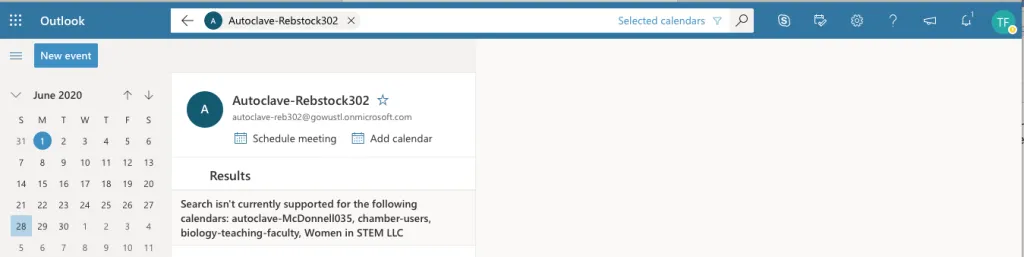
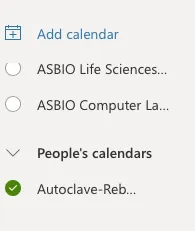
The calendar will now be added under People's calendars on the right side of the screen. When adding an item make sure the correct calender has been highlighted.
To add a calendar to Outlook for the Mac:
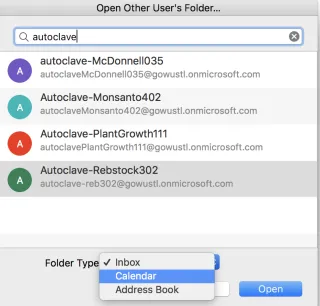
Click File then Open other User Calendar.

In the pop-up window begin typing autoclave in the search box and the autoclave room numbers will be listed. Select the autoclave calendar you would like to open. Make sure and select Calendar from the pull down Folder Type:
In a few moments you will receive the following message:
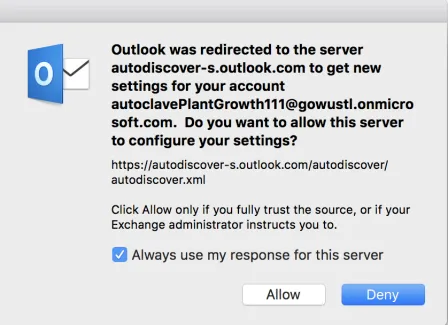
Make sure and check “Always use my response for this server” and then press “Allow” The shared calendar will then appear in your calendar list. Make sure to highlight the calendar in your calendar list before adding an entry.
Social Distancing, Hygiene, and Workplace Safety Measures
1. Screening: Employees will be required to engage in daily self-screening to assess whether they are experiencing symptoms of COVID-19 or whether they have been in close contact with someone who has or is presumed to have COVID-19 within the past 14 days. If an employee fails the screening, they are not permitted to come to work on campus and must be medically cleared by an occupational health professional before returning
2. Six feet apart: Adapt the workspace to facilitate social distancing and allow employees to remain six feet apart from one another.
3. No face‐to‐face meetings: Continue conducting your meetings via telephone or web conference (Zoom) even if in the same common office setting, and discourage face-to-face meetings unless absolutely necessary.
4. Workspace modifications: Create other modifications to the workspace or building facility to facilitate social distancing, in consultation with Environmental Health & Safety (EH&S) (general office space: Brad King; research space: Angela Dartt) and Facilities (JD Long and Robert Hall):
a. One-way entrance/exit
b. One-way office hallways or aisles
c. Plexiglass or other partitions to serve as sneeze guards/shields if appropriate d. Use painter’s tape or other floor markings to designate 6ft distance in hallways/aisleways.
5. Personal hygiene: Post signs and remind employees to engage in best practices with respect to their personal hygiene:
a. Wash your hands often with soap and water for at least 20 seconds especially after you have been in a public place, or after blowing your nose, coughing, or sneezing.
b. If soap and water are not readily available, use a hand sanitizer that contains at least 60% alcohol. Cover all surfaces of your hands and rub them together until they feel dry.
c. Avoid touching your eyes, nose, and mouth with unwashed hands.
d. Cover your mouth and nose with a cloth face cover when around others because you can spread COVID-19 to others even if you don’t feel sick.
e. When wearing a cloth face cover, continue to keep at least 6 feet between yourself and others. The cloth face cover is not a substitute for social distancing.
f. Cover your mouth and nose with a tissue when you cough or sneeze or use the inside of your elbow if you are not wearing a face covering. Throw used tissues in the trash. Immediately wash your hands or use hand sanitizer.
6. Cleaning and Disinfection: Remind employees to clean frequently used office equipment and frequently touched surfaces (e.g., desks, tables, handles, computer keyboards,
7. Face masks: Strongly encourage or require employees to wear cloth face masks while working on campus when not alone in their individual, closed office space. The university anticipates providing a cloth face mask to each employee who returns to work on campus as part of the Phase 1 Return to Work package that each employee will receive.
8. Other PPE: Provide the requisite personal protective equipment (PPE) to employees based upon their job responsibilities. Consult with EH&S if you have questions regarding the required PPE.
9. Staggered work schedules: Where possible, schedules or shifts among employees should be staggered such that social distancing can be more easily maintained. Consider allowing employees to continue working from home for an agreed upon number of days per week where possible.
10. Restricted building access: Employees returning to campus must limit movement around campus to areas identified with their managers. Employees will be required to swipe into buildings to identify the building locations where the employee was present in the event the health department needs to engage in contact tracing.
11. Lunch and breaks: Employees should be encouraged to eat lunch and take breaks alone either in their office or outside while maintaining proper social distance from others. Campus dining facilities that normally allow for communal dining will not have available seating. Stagger break and lunch periods to minimize the number of employees in a common area.
12. Office common areas and equipment: Restrict the number of employees permitted in office common areas at one time. Provide sanitizing wipes and instruct employees to sanitize microwaves, coffee pots, printers, and other communal items in break rooms, kitchens or other office common areas after each use. Discourage employees from sharing office equipment (e.g., telephones, computers, mouse).
13. Child Care: Some employees are likely to struggle with securing reliable and safe childcare; children of employees are not permitted on campus per the Children in the Workplace Policy. In addition, employees should consult with HR, as the employee may be entitled to certain COVID-19 related leave benefits.
14. Vulnerable populations: If an employee shares that they have a health condition or other high-risk factor that makes them particularly vulnerable to COVID-19 complications, discuss providing accommodations to that employee in consultation with HR. Do not prevent employees in higher-risk populations from returning to work if they wish to do so.
15. Employee concerns: If an employee has health or safety concerns about returning to work on campus, the decision to return is ultimately left to the employee, and their decision should be made in consultation with their physician. If an employee expresses concern for their safety in returning to work, consult with HR, as there may be accommodations available to ease their concerns (e.g., PPE). In addition, the employee may be entitled to certain leave benefits.
16. Training: Managers should ensure that employees are trained on all best practices and protocols related to COVID-19, and attendance and sick leave policies before returning to campus. These best practices and protocols should be posted in the work areas.