Two Washington University in St. Louis graduates, Michael Boekman and Heidi David, recently published research from their advanced biology lab course Structural Bioinformatics of Proteins (BIOL 4525) in ACS Omega - a reputable, peer-reviewed journal.

Advanced labs like BIOL 4525 offer students the opportunity to meaningfully combine academic learning and laboratory skills to showcase mastery in research techniques and develop scientific inquiry.
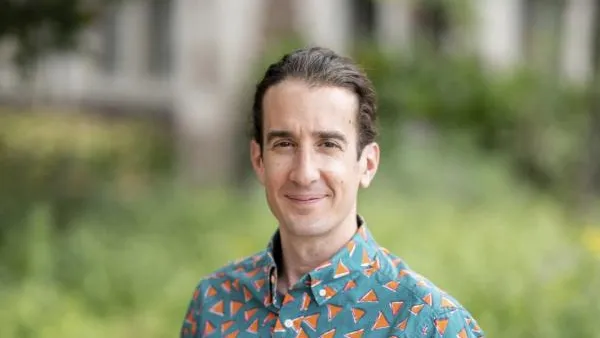
Boekman and David’s paper provides a structural and functional characterization of nucleoside diphosphate kinase (NDPK) from Trypanosoma brucei, the parasite that causes African sleeping sickness. The research was conducted under the guidance of Dr. Craig Smith, Associate Director of Undergraduate Studies, who currently teaches the course. His primary interests are protein structure, structural bioinformatics, and using computational tools to understand protein function. “Much of my work in the classroom focuses on analyzing newly determined protein structures and helping students connect structure to biological function,” says Smith.
In this class, students participate in a course-based research experience, where they analyze newly solved protein structures. Boekman and David’s work, for instance, involved detailed structural analysis: identifying key features of the active site, characterizing substrate interactions including a flexible loop involved in nucleotide recognition and noncovalent interactions that stabilize substrate binding, and comparing multiple structural states of the protein. They analyzed several datasets and identified features, which raised interesting questions about TbNDPK’s function.
To test this experimentally, a highly collaborative research team was formed. Owing to Boeckman and David’s promising work in his lab, Smith connected them to Dr. Chakafana at Hampton University. “Through him, I was introduced to Dr. Achilonu,” explained Smith, “This led to the collaboration with groups at Hampton University and in Johannesburg, who have the experimental expertise needed to test the hypotheses generated by our computational analyses.” They conducted experiments to both functionally and structurally characterize TbNDPK, using research methods such as circular dichroism and fluorescence spectroscopy. Their results found TbNDPK to be a thermostable, catalytically efficient, and structurally distinct enzyme. They showed it to be optimized for ribonucleotide metabolism and supported its potential as a selective target for future antitrypanosomal drug discovery, which provides an interesting application in pharmacology.
Michael Boeckman and Heidi David's work, under Dr. Craig Smith’s leadership is truly commendable. This project is a true testament to the impact of consistent dedication, meaningful scientific application and sustained interest from two undergraduate students in a CURE setting, which provides invaluable resources for their hard work to flourish. It demonstrates that when students engage in authentic research, they can contribute meaningfully to publication-quality scientific work. Moreover, it can inspire partnerships between institutions, both increasing participation and overcoming structural boundaries.