A conversation with Amy Angert AB '98 about ecology, the Losos Lab, and the joy of the unexpected.
Amy Angert AB ‘98 is an ecologist through and through. A professor in the Department of Botany at the University of British Columbia in Vancouver, her lab tackles all things related to evolutionary ecology.
But this wasn’t always where she thought she’d end up.
Armed with the Arthur Holly Compton fellowship, Angert, like many WashU students, had her sights set on pre-med when she arrived in St. Louis in the fall of ‘94. “Biology was definitely the plan. Ecology was not,” she told me during a conversation this past fall. “I had very little idea about the diversity of things one could do with a biology degree.
Then, her sophomore year came around, and one class showed her what was possible. “It was when I took Jonathan Losos’ evolution class that the world just opened up.”
Angert admitted that while she’d always loved nature and the outdoors, she thought that science was white lab coats and not much else. It’s a common misconception, but nothing a good teacher can’t fix.
“Jonathan’s class showed me that there was science within nature. That was transformational for me.”
This class shifted her career path, and at the end of that year, with the help of an HHMI Howard Hughes research fellowship, she looked for ecology labs to join. Somewhat unexpectedly, she ended up in the Losos Lab, the first undergraduate to ever do so.
“Even as a beginning undergraduate, she had a passion for both plants and ecology,” Jonathan Losos, William H. Danforth Distinguished University Professor, told me. And even though the Biology Department had plant biologists and ecologists, they had no plant ecologists. “She met with Barbara Schaal who said that if she wanted to do field work, she should talk to me,” he continued. “And that’s how she ended up doing a fabulous study on collared lizards.”
The research Angert began that summer with Losos centered around the microhabitat use of these collared lizards in the Missouri glades, the open, dry clearings within wooded areas. And the work Angert did eventually led to a publication in the Journal of Herpetology—the very first publication listed on her CV. Losos added that this paper has been cited more than sixty times.
“Of course, I was sure that after this wonderful experience, Amy would ditch her botanical aspirations and continue on to a glorious career as a herpetologist,” Losos joked. “And glorious it has been, but sadly botanically based.” Losos added that he’s not surprised by Angert’s success. “You could already see the makings of a great scientist when she was an undergraduate.”
Like Losos, Angert noted that the research she did at WashU is different from what she does now (for one, she’s not studying lizards), but she can still trace the beginnings of her lab to the work she did that summer in St. Louis.
She described the landscape she was working on then: “Here we are in Missouri, in these clearings in the deciduous forest, you’ve got rock outcrops. You’ve got collared lizards. You’ve got scorpions and tarantulas and prickly pear cactus.”
That’s not a list of things many people would expect to find in the Midwest. “It’s this absolutely bizarre outpost of the desert southwest, popping up in Missouri.”
This idea, that species can move and adapt to new, often unexpected, environments, followed Angert to graduate school, where she worked on species distribution and range limits, and eventually to her current lab, where she focuses on Mimulus (the monkeyflower).
“It was so evocative to me, because it was encapsulating what I experienced in Missouri,” she explained, referring to her interest in species’, often odd, range limits. “That’s the central mystery that my research has been addressing ever since.”
But Angert’s career path was never just about the research; it’s also been about her love of academia.
“I’m the kind of nerd who went to school as long as I could, until there wasn’t any more school to do,” she said. “I never really wanted to leave the academic environment. I love the atmosphere of curiosity and learning and discovery.”
She credits this view to the Losos Lab, where her fellow researchers were a constant support system, both scientifically and socially.
“They were very welcoming and inclusive,” she explained. “There wasn’t a big hierarchy. Jonathan would sit with me out at the lab computer and help me with analyses. Grad students would invite us over for potlucks. I wanted to continue being a part of communities like that.”
And those values, the ones that create inclusive, supportive communities, have been at the front of Angert’s mind as she’s built up her research program at the University of British Columbia.
“I’m always trying to make sure that people are supported, not just for their work, but having work life balance, and trying to keep the camaraderie and sense of community at the forefront.”
Angert recognizes that it’s often hard to stay motivated as a student researcher, and that it’s partly her job to help her team through that. “If it’s not something they’re inspired by and something that’s fun, then it starts to feel like, what’s the point? Or, why would I keep doing this?” she elaborated. “So, you have to make it something that they keep choosing.”
The research community that Angert has built is currently working on those aforementioned questions of range limits, specifically the ecological and evolutionary factors that contribute to them. And these types of big-picture questions demand a multitude of research approaches—growth chamber studies, demographic modeling, experimental transplants…
“I would say I’m a jack of all trades and master of none, which gives me some trepidation sometimes,” Angert said. “But I think it’s because we have a question-driven approach, and sometimes the questions require us to bring in new tools.”
This approach comes second nature to Angert. She has always gone where the questions lead her, from her initial discovery of ecology to her current research projects; she figures out what methodologies and collaborations to bring in along the way.
“I think it gives us the ability to synthesize lines of evidence that don’t often come together in the same study system,” she says. “That’s one of the most exciting parts.”
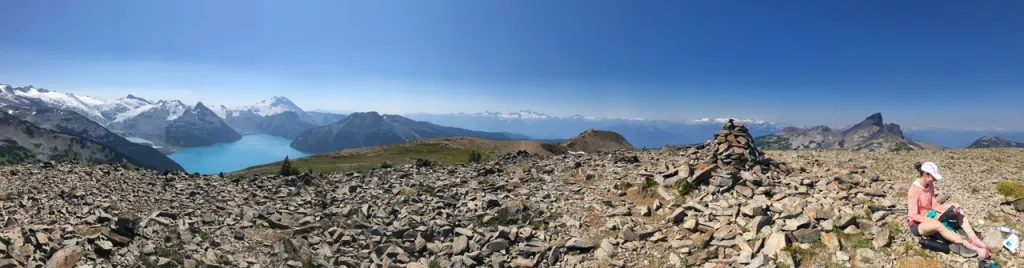
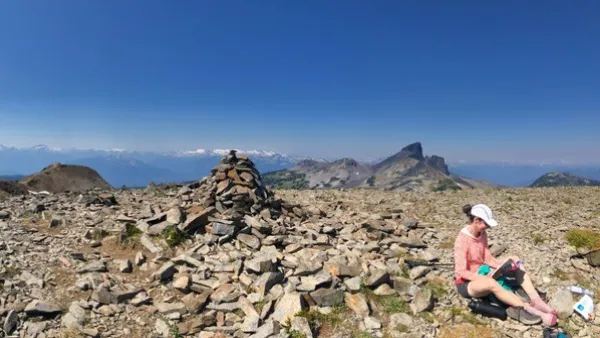
Amy Angert doing field research in Garibaldi Provicial Park, BC this past summer (Photo Cred: Amy Angert and Courtney Collins)