Snoderly-Foster talks about her background and the new lab course BIOL 3111 Human and Comparative Anatomy
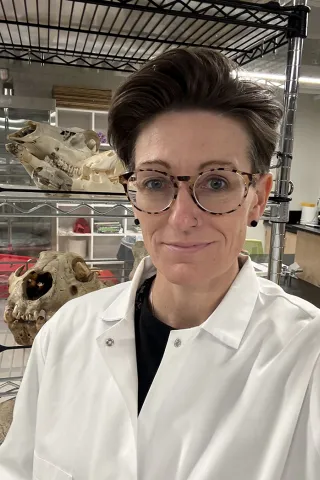
Where are you from or where did you grow up?
I grew up in a small, rural town two hours southwest of St. Louis called LaQuey, Missouri. My upbringing was very typical of a family in a small midwestern town. My parents own a small farm, so I spent a lot of my childhood surrounded by nature—riding horses, caring for livestock, tending a garden, fishing . . . I attended the same school K - 12 and graduated with 30 other people, most of which I had been in class with since early elementary school.
Was there an experience early in life that got you interested in science, either general or more specifically the field of science that you teach now?
My interest in animal sciences stems from my experiences on the farm, but I have experienced some truly inspirational teachers along the way that helped broaden my interests to all other aspects of science, from my fifth grade science teacher to my high school chemistry teacher. I had no clue what career path I wanted to choose after high school, but I knew I was generally interested in science. I had an unquenchable thirst for understanding the way things work, and science is where I found those answers. It wasn't until I took Human Anatomy and Physiology in college that any one branch of science really grabbed my attention. I have a diverse educational and teaching background, but that class is where it all started, and I have held ties to teaching human anatomy for most of my educational and teaching career. After completing the course, I approached my A&P instructor about serving as an undergraduate TA for her course and spent the next 3 years serving as an assistant in the lab. I went on to teach human A&P lab as a graduate TA at both Missouri University of Science and Technology and University of Missouri - St. Louis, and also taught Human A&P for the nursing program at Ozark Technical Community College between my master's and my PhD program.
What is your educational background?
I earned a Bachelor of Science in Biology from Southwest Baptist University in 2003, a Bachelor of Arts in Biology with a secondary education certification from Missouri University of Science and Technology in 2012, a Master of Science in Applied and Environmental Biology from Missouri University of Science and Technology in 2014, and a PhD In Cell and Molecular Biology from the University of Missouri - St. Louis in 2022. I did not pursue a traditional post-doc after my PhD, but I did work as a Staff Scientist in the lab of Dr. Victor Tse at the Doisy Research Center at Saint Louis University for about a year before accepting my current position as the General Chemistry Lab Coordinator at Saint Louis University.
What brought you to WashU, can you talk about your work here?
I have been with WashU a little under 2 years. I was brought in to teach the Human Anatomy and Physiology lectures for the Post-Baccalaureate Pre-Med (PBPM) program for the 2024-2025 academic year. After that year, three storms converged: the PBPM program closed, Dr. Keadle (the former Vertebrate Structures Lab instructor) retired, and the department acquired the Anatomage digital dissection table. Dr. Keadle's retirement left an opening for an instructor for the Vertebrate Structures Lab course and the closure of the PBPM program created a need for a human-focused anatomy course to serve our pre-med students. I was approached to work with Dr. Dixit and Dr. Osdoby in the Biology Department to reimagine the Vertebrate Structures Lab course to include more human anatomy while retaining comparative vertebrate aspects, and to integrate the new digital dissection table as a core element of the curriculum redesign. I spent last summer developing the new Human and Comparative Anatomy course, BIOL 3111, expected to be offered in Fall 2026.
What do you love about teaching undergrads?
I truly have a passion for teaching others; I love to disseminate knowledge. Teaching at the college level opens the door to teaching subjects in-depth and fostering critical thinking. I love when students’ curiosity is stimulated and they challenge me with questions. Sometimes I don't have the answers, so we find them together. In these moments I build stronger bonds with my students and grow in my knowledge as well. But honestly, my favorite part of teaching undergraduates is the mentorship. As a first-generation college student, my college career was a solo journey that many times felt like walking through a dark, unfamiliar room. Part of my teaching philosophy is to serve the whole student, to provide them with support in all areas of their student life, not just in helping them realize their career aspirations. I am always so impressed by how driven my students are and I know the hard work and dedication it takes to do what they are doing, so I try to offer them small gems of wisdom gained through experience and promote the importance of physical and mental health in successful learning.
Are there any other hobbies or interests you would like to share?
In my free time, I enjoy playing recreational sand volleyball, exercising, cooking, painting, and watching movies with my beautiful children.
Can you talk about how the new course, BIOL 3111 Human and Comparative Anatomy, will be different from the current version, BIOL 3110 Vertebrate Structures Lab?
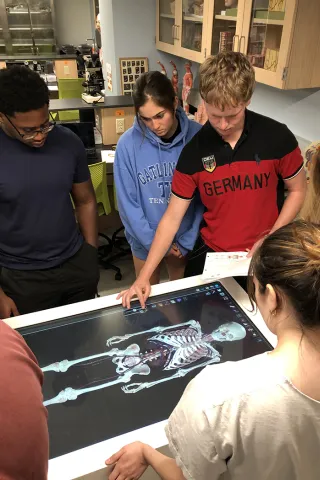
In the Vertebrate Structures Lab course, students examine chordate evolution and anatomy of representatives from major vertebrate classifications (early chordates, fish, amphibian, reptile, bird, and mammal) using a comparative approach, with a small nod to humans as members of the mammalian class. The new Human and Comparative Anatomy course will be similar to a traditional human A&P course but is focused on anatomical structure only (with occasional reference to physiology where necessary to understand anatomy) and is condensed to cover all body systems in a single semester. The course will retain the comparative approach to a lesser degree, continuing to include study of the same representatives of other classes of vertebrates, but specifically in the context of understanding how environment and behavior influence form. This allows the course to serve a broader audience of pre-med students, including those who will be entering into veterinary medicine.
Dissection of animal specimens was always a major aspect of the Vertebrate Structures Lab course and students of the Human Comparative Anatomy Lab course will also be dissecting real specimens; it remains an important means for students to experience real body tissues. However, in the new course, we have adopted a new and exciting technology that is at the pinnacle of teaching human anatomy, the Anatomage digital dissection table. The table contains high resolution digital human cadavers that have been constructed using scans of real human cadavers. The cadavers can be dissected in a number of ways to allow students to manipulate structures for a 3-dimensional view within the context of the whole body and on a real scale. The table also contains hundreds of real diagnostic scans (CT, MRI, etc) demonstrating a variety of injuries and pathologies one might encounter in the field, providing us with tools to help students connect their newly acquired knowledge of the human body with clinical applications. This course offers a fun, engaging, and clinically-relevant way for anyone to learn about the human body. Whether you are working towards a career in medicine or just want to know more about the human body, this course offers a comprehensive approach to understanding the human form.