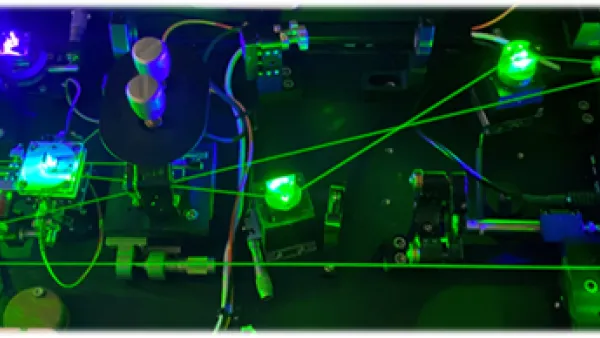
Now a part of the Biology Department, Dariusz (Darek) Niedzwiedzki, Ph.D. leads the Ultrafast Laser Facility, one of the university’s most advanced research spaces. His work focuses on measuring some of the fastest events in nature, processes so quick that they are impossible to capture with conventional tools.
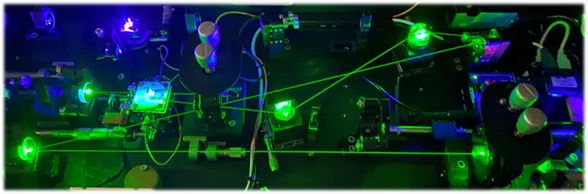
The term “laser” may conjure up images of small laser pointers, but an ultrafast laser is far more complex. “The term ‘ultrafast laser’ is more like a euphemism,” Niedzwiedzki said. “In reality, it covers a whole multicomponent infrastructure built around that kind of laser for specific experiments.”
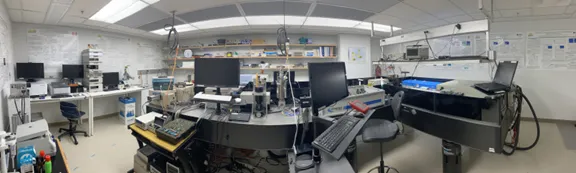
The facility includes amplifiers, optical components, detectors, and other highly specialized devices. Each piece is carefully arranged to generate, control, and measure extremely short pulses of light.
To understand why these ultrafast measurements are needed in the first place, you must first understand that the “human visual system” is inadequate. “It is not a secret that the human brain and eyes are just too slow to resolve fast phenomena,” Niedzwiedzki said. Most people can distinguish events that last around 100 milliseconds. Anything faster—a hummingbird’s wings, a fly—begins to blur. But nature operates on timescales even faster than that.
In the Ultrafast Laser Facility, researchers can observe these events, the ones that occur within a few hundred femtoseconds. That’s one quadrillionth of a second. “If we put it in perspective, one femtosecond to one second would be like one hour to the age of the universe,” Niedzwiedzki said.
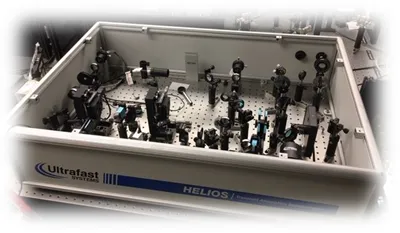
Those timescales are where many important biological and chemical events happen, especially those triggered by light. Potential projects can range from examining molecules used in photocatalysis, to studying photosensitizers for phototherapy applications, to investigating light-sensitive proteins or materials designed for light-to-electricity conversion. The facility can also accommodate samples in liquids, solids, thin films, or gels and at temperatures ranging from room temperature down to liquid nitrogen.
“It is unique,” Niedzwiedzki said.
But one of the most powerful applications of ultrafast spectroscopy is in the study of photosynthesis. The technique has had “tremendous success” in this field, according to Niedzwiedzki. When pigments absorb sunlight, the captured energy is passed between specialized proteins called light-harvesting antenna complexes before reaching reaction centers, where chemical reactions begin.
“The timescale of those early photosynthetic events is ultrafast,” Niedzwiedzki explained. “They typically occur within sub-picoseconds and nanoseconds.” Without ultrafast measurements, these moments would remain hidden.
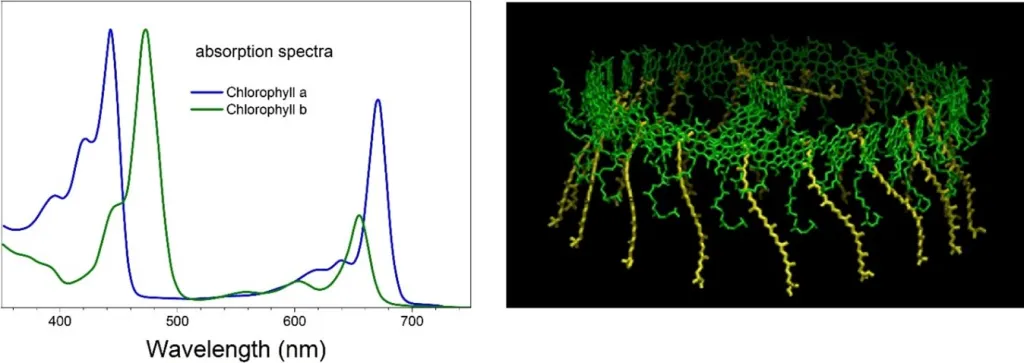
For researchers who are new to these laser-based techniques, Darek offers a straightforward guideline: “If you work with biological systems that are somehow involved in light absorption or emission, ultrafast spectroscopy could be a perfect tool.”
Under Niedzwiedzki’s leadership the Ultrafast Laser Facility gives the Biology Department the ability to study life, no matter the speed at which it happens.
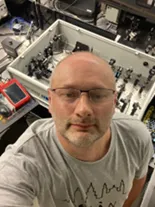
Dariusz (Darek) Niedzwiedzki, Ph.D. In 2004, he graduated in physics at Maria Curie-Sklodowska University. He currently manages Ultrafast Laser Facility at Department of Biology. He specializes in application of spectroscopic methods to various research areas with photosynthesis as his favorite one. His research was published in over 150 articles spread in over 40 journals ranging from food science to applied physics. Ironically, his scientific journey started with publications on 200-million-year-old dinosaur (therapods) tracks from Lower Jurassic though later. In almost an “ultrafast” fashion, he quickly transitioned with research interests to events occurring in a much shorter time scales.
If you are interested in research that is conducted in the ultrafast laser facility, please visit facility’s website for more details (https://sites.wustl.edu/ultrafastlaser/whats-new/ ) or write email to Darek Niedzwiedzki (niedzwiedzki@wustl.edu). You can also stop by in person for the facility tour. The facility locates in Brauer Hall, rooms 022-23.