
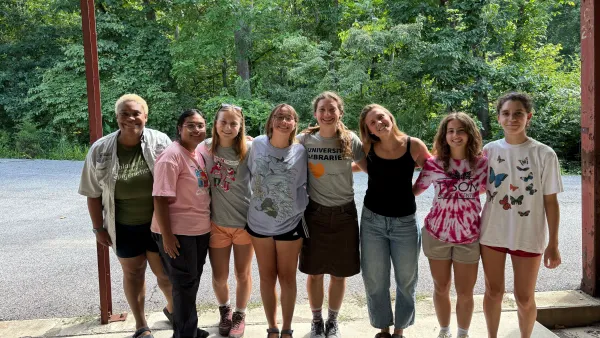
Program Coordinator Anthony Smith, and undergrad students Anna Tourney and Auriel Prepejchal talk about the Biology Undergraduate Independent Research Program
The Biology Undergraduate Independent Research Program, offered through the Biology Department at WashU, provides students with a unique opportunity to pursue research autonomously in their field of choice, under the guidance of esteemed faculty mentors. From field research and data analysis to lab work and clinical studies BIOL 2901/4950 seeks to encompass the broad interests and specializations of Biology Majors.
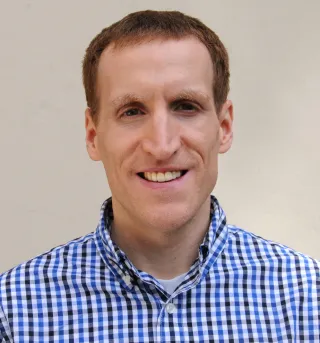
The Director of the Program and Senior Lecturer, Anthony Smith, says “I want students to start working on communicating science,” a key skill that comes with the pursuit of scientific inquiry and application.
Dr. Smith also teaches Hallmarks of Cancer and runs the Ambassador Program. He is the point person for the Research Honors Theses in Biology. He was a PreHealth biology major at WashU before getting his doctorate. He then practiced as a postdoc researcher before transitioning to teaching and leadership as an assistant dean in Arts & Sciences back at WashU.
“A lot of students want to get into research to have the accolades that come with getting a publication,” says Smith. However, that is not as important a priority to both him and graduate schools as the many proficiencies that develop with research. “A good experience for the undergrad is being comfortable with science, in talking and thinking about it”, says Smith. The experience supplements classroom learning and allows students to familiarize themselves with applications of biology in various contexts.
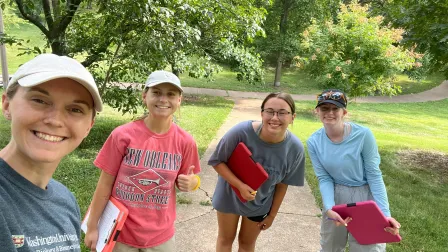
The Penczykowski Lab is an example of the immense diversity in research that the Independent Study Program offers to biology students. Anna Tourney, an undergraduate researcher in the lab, is pursuing an Environmental Biology major. She speaks fondly of her experience on the disease ecology side of the lab’s field and bench research, highlighting that her research has allowed her to gain exposure and curate her own research project.
Tourney is from rural Missouri and her formative experiences have informed her research interests. She is passionate about understanding the effect of climate variables on agriculture, “I love disease ecology— studying agriculture and the impact of climate change. Over the summer, I started my independent research project on the presence of herbivory species in the urbanization gradient, which I continued into the academic year,” Tourney explains. She does this by recording and analyzing changing patterns in fungal pathogen growth and its effect on crop growth. She is also an avid hiker and enjoys fishing, thus, she cherishes that her research allows her to be outdoors and visit various sites in St Louis.
In contrast, Auriel Prepejchal, a Computational Biology Major, applies her research in the lab to a more computational setting, with an independent focus on disease tracking. “There are 22 different sites in the Greater St Louis Area … We go to the simulated garden beds and measure the leaves, count the stems, and check for disease on the plants. I now work on disease tracking and how disease spread works … It has been very helpful in understanding plant disease dynamics,” she explains.
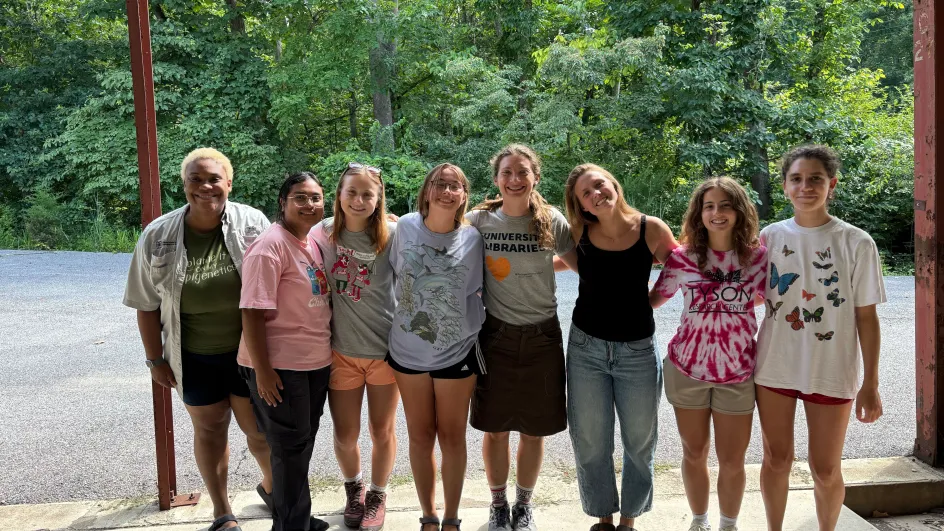
Prepejchal’s research highlights how there is a novel application for her specific interest. She performs computational analysis on disease spread in urban areas. “I am creating a mathematical model which looks at urbanization … As a computational Biology Major, it is nice to take the field work and apply it in the simulation coding setting,” she explains. Prepejchal worked on a farm for many years before joining her research lab, where she dealt with managing novel crop diseases. Her research has now provided her with hands-on experience in understanding plant disease dynamics, in a well-known setting. She wants to continue to build on her research when she applies to graduate school.
To get started on the application for Biology Independent Research, students should think about their own research areas of interest and utilize the plethora of resources on the course website to find a mentor who works in a field that piques their interest. Tourney found the research lab of her choice through Handshake, while Prepejchal took a class with Dr. Penczykowski. The independent research course website has a large list of potential mentors for students to browse, along with helpful suggestions on how to approach and secure a mentor, as well as tips for writing the research proposal.
Something for students to keep in mind is that the transition to Workday means stricter application deadlines. “With centralization of the enrollment process, we have strict deadlines to submit research proposals to the department by the first Friday of the semester in which they plan to earn credit for their research,” highlights Smith, adding that there are plenty of resources for students to find a research mentor and prepare their proposal ahead of time.
This webpage created by a group of undergrads called Biology Research Ambassadors is another great resource for students. They can connect with Dr. Smith directly or his research ambassador team to make the initially daunting process more accessible.
